
Case StudiesAt Surrey Ion Beam Center, we leverage cutting-edge ion beam technologies to drive innovation across a wide range of industries. Our research focuses on applying ion beams for material modification, environmental monitoring, medical treatments, and more. Here are some examples of our impactful case studies.
Each case study demonstrates our commitment to pushing the boundaries of ion beam research and contributing to advancements that address real-world challenges. Our work continues to support the development of innovative solutions for a range of applications, from healthcare to manufacturing and environmental protection.

Traditional Ion Implantation is often used in the semiconductor industry to change the electronic properties of materials by introducing dopant ions into the semiconductor.
Ion implantation offers a unique way of transferring thin layers of single crystal material from one wafer to another.
We can use Ion Beam Analysis – PIXE – to look at the trace elements in Cultural Heritage Materials to provide insight in to provenance and origins of the materials.
MicroPIXE can be used to correctly identify the metal atoms in metaloproteins. X-ray crystallography is very good at identifying the important structure of the protein…
Gunshot residue (GSR) is conventionally studied by SEM-EDS. We use Ion Beam Analysis – PIXE – to look for GSR signatures in cases where SEM-EDS is unable to detect all…
Semiconducting amorphous iron disilicide (a-FeSi2) can be made by ion beam mixing a multilayer stack of pure Fe and Si layers.
Traditional Ion Implantation is often used in the semiconductor industry to change the electronic properties of materials by introducing dopant ions into the semiconductor.
Ion implantation offers a unique way of transferring thin layers of single crystal material from one wafer to another.
We can use Ion Beam Analysis – PIXE – to look at the trace elements in Cultural Heritage Materials to provide insight in to provenance and origins of the materials.
MicroPIXE can be used to correctly identify the metal atoms in metaloproteins. X-ray crystallography is very good at identifying the important structure of the protein…
Gunshot residue (GSR) is conventionally studied by SEM-EDS. We use Ion Beam Analysis – PIXE – to look for GSR signatures in cases where SEM-EDS is unable to detect all…
Semiconducting amorphous iron disilicide (a-FeSi2) can be made by ion beam mixing a multilayer stack of pure Fe and Si layers.
Luke.Antwis@surrey.ac.uk
+44 (0)1483 689145
Surrey Ion Beam Centre,
University of Surrey,
Guildford, Surrey,
GU2 7XH, UK.
If the Validator declines to validate, they are asked for a reason by the UKNIBC, which communicates this to the proposer. But if the proposal is validated, the project starts immediately.
The Validator (if required) is not a referee, although s/he is welcome (and encouraged) to make comments on proposal quality. Indeed, such comments will be helpful to rank proposals in the event that the UKNIBC is oversubscribed.
However, the UKNIBC funding is classed by EPSRC as already refereed, so the primary purpose of the Validator is purely as an independent confirmation that UKNIBC resource is being applied appropriately.
The FAF will contain all appropriate details, including the user’s name (and also the PI’s, if it is different). A Summary Statement of the Grant Holder shows how the proposed project is related to the EPSRC grant named. A Summary of UKNIBC Contribution to the Project includes the specifics of the work proposed at the Facility. This should be detailed enough to justify the resource requested.
The request is further refined following the review by the team. The Discussion will be documented (via email), and may be as detailed and extended as required.
The request is reviewed. Someone at the Local Facility (the Liaison Fellow, LF) is chosen to discuss the request with the user through the contact details shared during request submission.
Potential users can approach the facility without any introduction. Conversely, Facility staff may have encouraged their contacts.
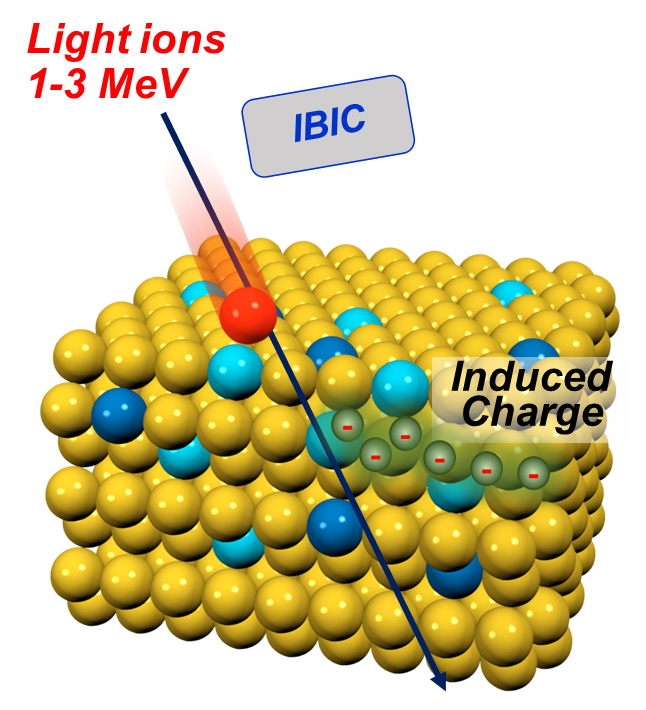
Ion Beam Induced Current (IBIC) : Measures the charge collection efficiency or current generated in an electronic or semiconductor device when irradiated with an ion beam. IBIC provides spatially resolved maps of electrical activity, carrier transport, and radiation damage, enabling the evaluation of detector performance and semiconductor device integrity.

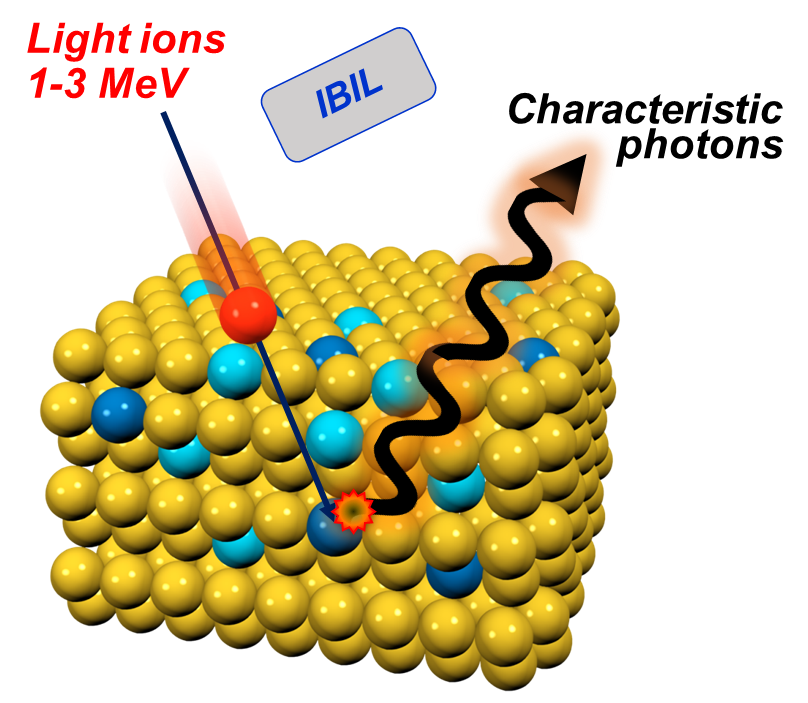
Ion Beam Induced Luminescence (IBIL) : Detects visible or near-visible photons emitted from the sample as a result of ion excitation. The luminescence spectrum reveals information about electronic structure, impurities, and defect states, making IBIL a valuable tool for studying semiconductors, minerals, and scintillating materials.

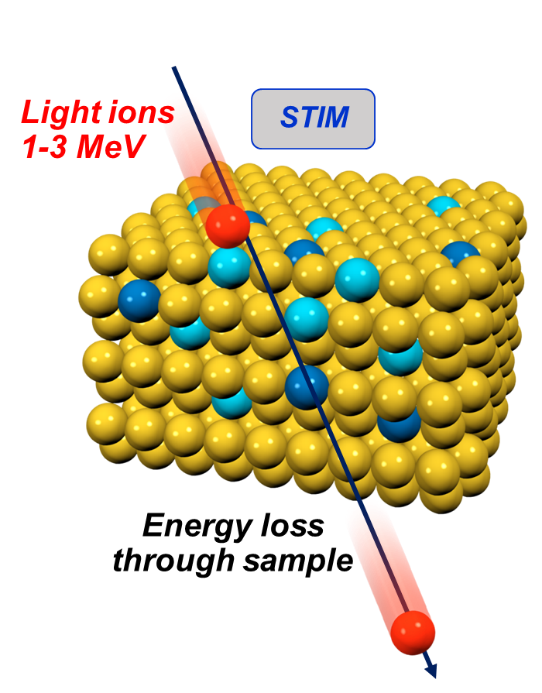
Scanning Transmission Ion Microscopy (STIM) : Uses a finely focused MeV ion beam scanned across a thin specimen. By measuring the energy loss or transmitted particle intensity, STIM provides quantitative two-dimensional or three-dimensional maps of areal density and thickness at sub-micrometer spatial resolution. It is particularly useful for biological samples, thin films, and microelectronic structures.

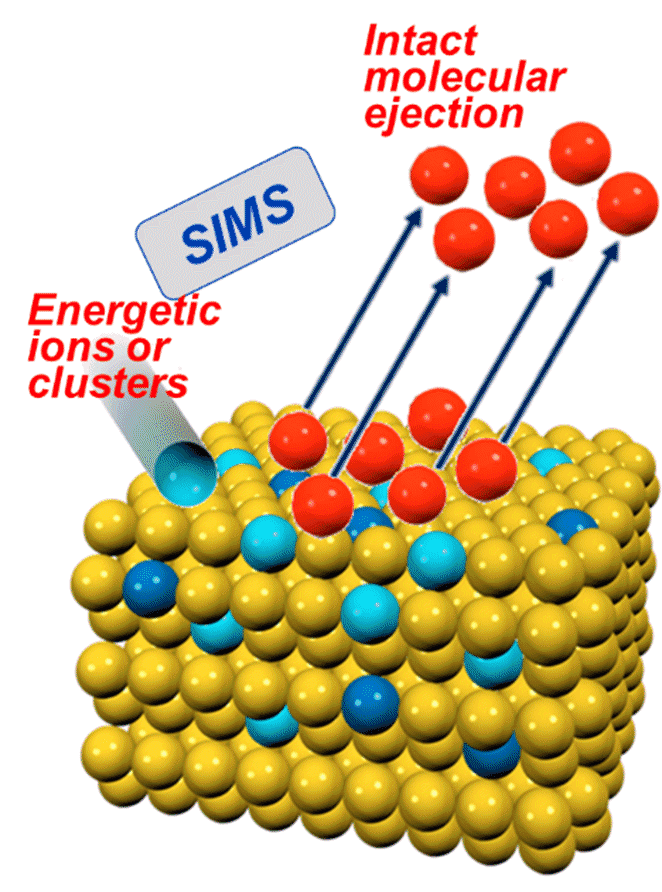
MeV Secondary Ion Mass Spectrometry (MeV-SIMS) : Combines the principles of SIMS with high-energy (MeV) primary ions. The electronic stopping processes at these energies produce significantly higher secondary ion yields with minimal fragmentation, allowing for molecular analysis while preserving depth resolution. MeV-SIMS bridges the gap between traditional SIMS and nuclear-based IBA, offering chemical and molecular information alongside elemental quantification.

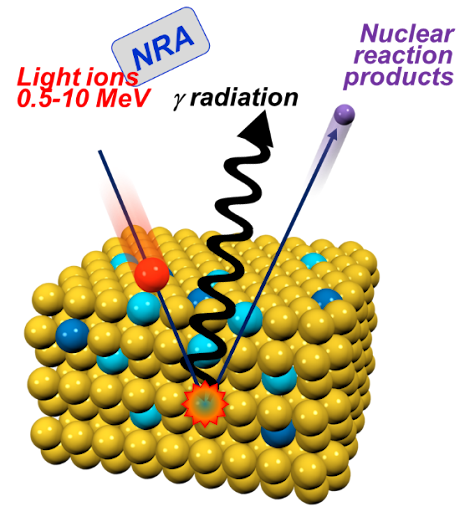
Nuclear Reaction Analysis (NRA) : Uses specific nuclear reactions to identify and quantify elements with high sensitivity.

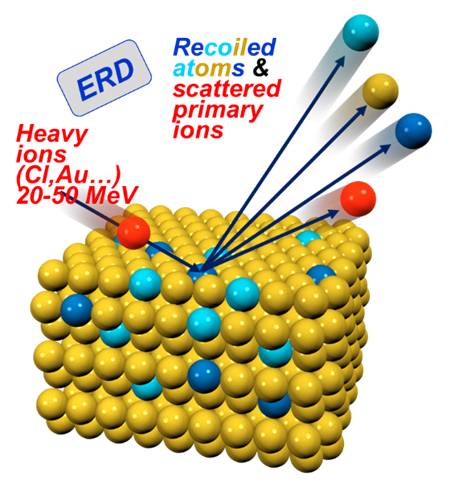
Elastic Recoil Detection Analysis (ERDA) : Detects atoms recoiling from the surface after ion impact, particularly useful for quantifying light elements such as hydrogen.

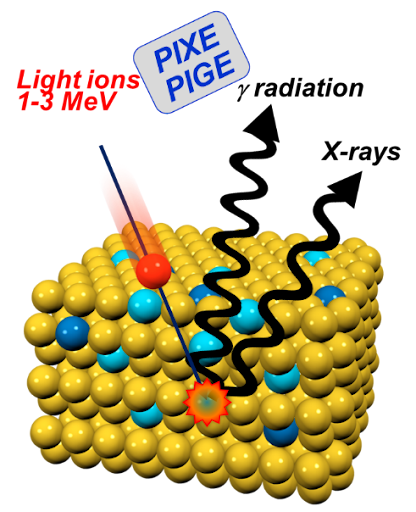
Particle-Induced X-ray Emission (PIXE) : Detects characteristic X-rays emitted when the incident ions ionize inner-shell electrons, allowing for multi-elemental analysis with high sensitivity.

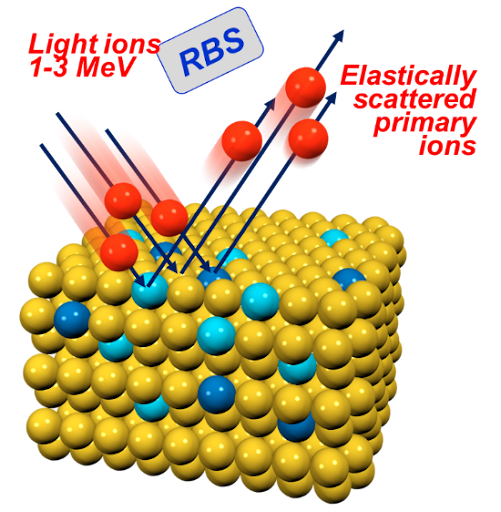
Rutherford Backscattering Spectrometry (RBS): Measures the energy of ions scattered elastically from nuclei, providing information on elemental composition and depth distribution.