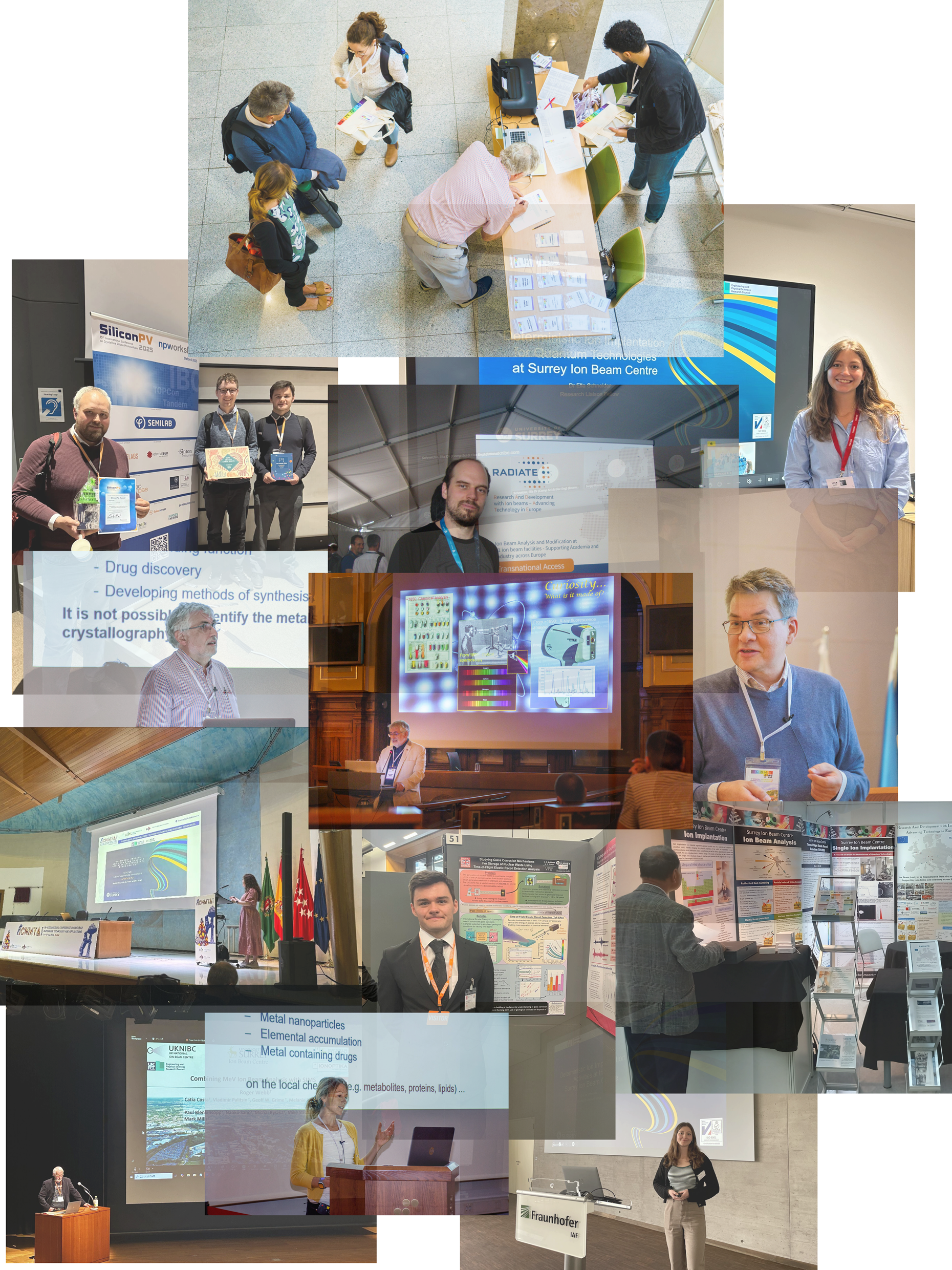

AboutThe IBC is committed to training the next generation of ion beam scientists as well as in expanding the current user base at ion beam infrastructures, through User Days, training courses and other outreach activities.
The UKNIBC holds an annual user day at which all users, past, present and future, are invited at attend and provide a presentation during the day, either as a poster or as an oral presentation. The User Days normally attract around 100 attendees with 50-60 user contributions. They also provide an opportunity for the UKNIBC to highlight upgrades and new facilities planned and to gauge support for these activities and to obtain feedback from users about ways of improving or enhancing the facilities.

All of the facilities in the UKNIBC run regular training courses for users and students, including an annual training course on the “Application of Ion Beams” with hands on training on the accelerators. The lectures will be given by specialists across the UKNIBC.
Members of the UKNIBC also work with the IAEA and the IoP to run technical meetings and training events at the ICTP in Trieste, the IAEA in Vienna and the IoP in London.
The SIBC provides one-to-one tuition for users who wish to perform their own detailed analysis of data obtained from the Ion Beam Analysis facilities using specialist software SIMNRA and OMDAQ. The SIBC has a training course for users and staff with a set of modules that the users can be tested on and given more responsibility to perform their own experiments as they pass the various components. Users following the training course are assigned a “Mentor”. Users are expected to learn the skills under their own steam by questioning, observing and emulating their mentor.
Satisfied
customer
Luke.Antwis@surrey.ac.uk
+44 (0)1483 689145
Surrey Ion Beam Centre,
University of Surrey,
Guildford, Surrey,
GU2 7XH, UK.
If the Validator declines to validate, they are asked for a reason by the UKNIBC, which communicates this to the proposer. But if the proposal is validated, the project starts immediately.
The Validator (if required) is not a referee, although s/he is welcome (and encouraged) to make comments on proposal quality. Indeed, such comments will be helpful to rank proposals in the event that the UKNIBC is oversubscribed.
However, the UKNIBC funding is classed by EPSRC as already refereed, so the primary purpose of the Validator is purely as an independent confirmation that UKNIBC resource is being applied appropriately.
The FAF will contain all appropriate details, including the user’s name (and also the PI’s, if it is different). A Summary Statement of the Grant Holder shows how the proposed project is related to the EPSRC grant named. A Summary of UKNIBC Contribution to the Project includes the specifics of the work proposed at the Facility. This should be detailed enough to justify the resource requested.
The request is further refined following the review by the team. The Discussion will be documented (via email), and may be as detailed and extended as required.
The request is reviewed. Someone at the Local Facility (the Liaison Fellow, LF) is chosen to discuss the request with the user through the contact details shared during request submission.
Potential users can approach the facility without any introduction. Conversely, Facility staff may have encouraged their contacts.
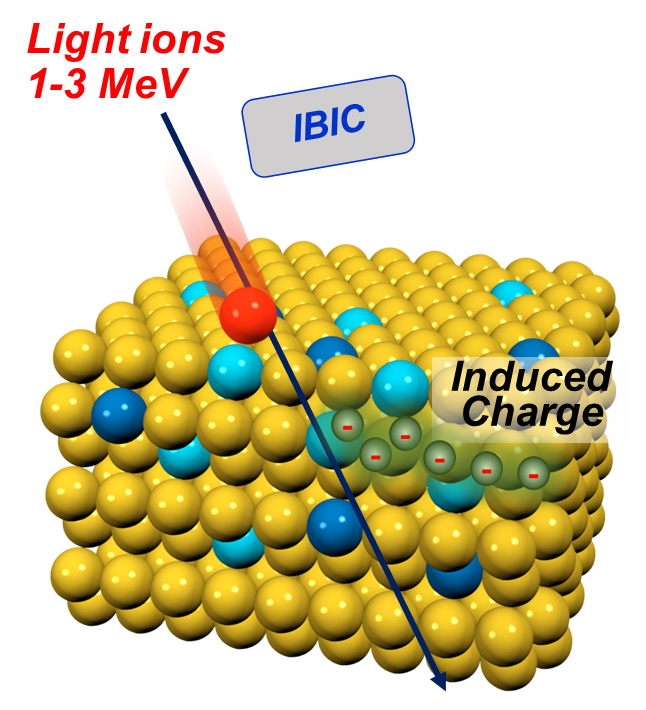
Ion Beam Induced Current (IBIC) : Measures the charge collection efficiency or current generated in an electronic or semiconductor device when irradiated with an ion beam. IBIC provides spatially resolved maps of electrical activity, carrier transport, and radiation damage, enabling the evaluation of detector performance and semiconductor device integrity.

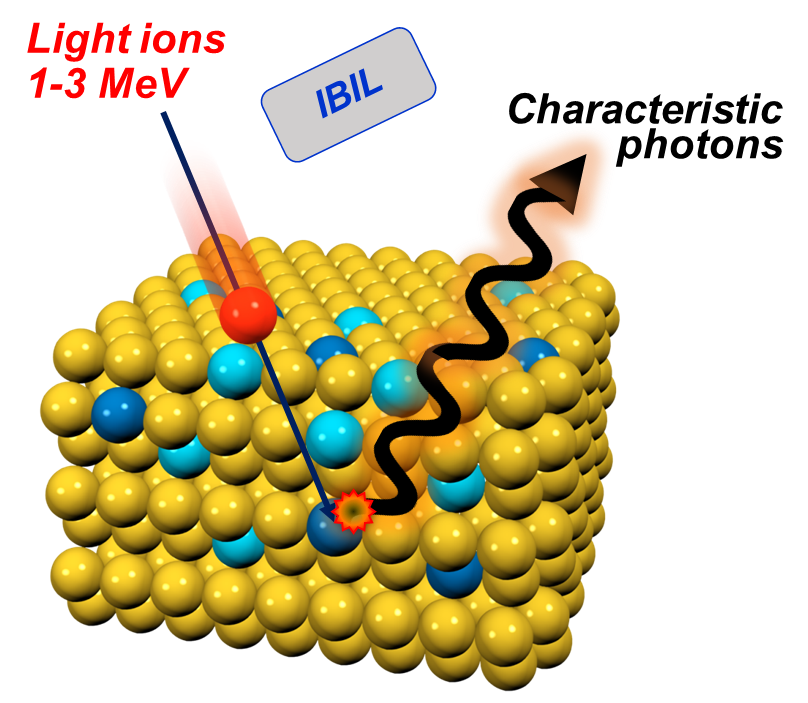
Ion Beam Induced Luminescence (IBIL) : Detects visible or near-visible photons emitted from the sample as a result of ion excitation. The luminescence spectrum reveals information about electronic structure, impurities, and defect states, making IBIL a valuable tool for studying semiconductors, minerals, and scintillating materials.

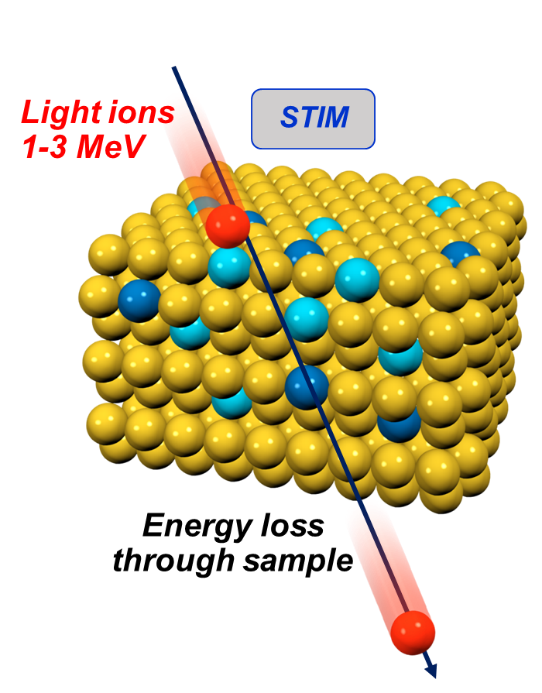
Scanning Transmission Ion Microscopy (STIM) : Uses a finely focused MeV ion beam scanned across a thin specimen. By measuring the energy loss or transmitted particle intensity, STIM provides quantitative two-dimensional or three-dimensional maps of areal density and thickness at sub-micrometer spatial resolution. It is particularly useful for biological samples, thin films, and microelectronic structures.

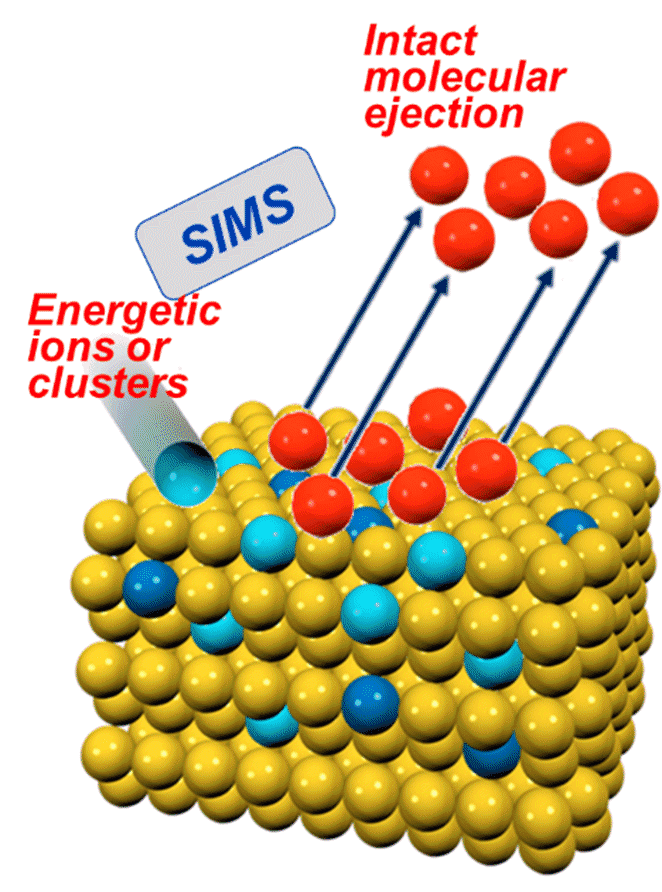
MeV Secondary Ion Mass Spectrometry (MeV-SIMS) : Combines the principles of SIMS with high-energy (MeV) primary ions. The electronic stopping processes at these energies produce significantly higher secondary ion yields with minimal fragmentation, allowing for molecular analysis while preserving depth resolution. MeV-SIMS bridges the gap between traditional SIMS and nuclear-based IBA, offering chemical and molecular information alongside elemental quantification.

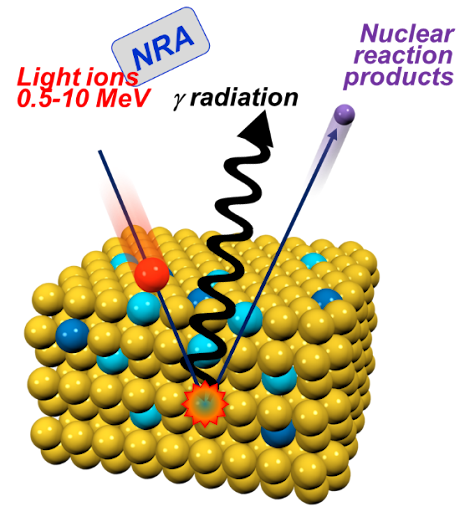
Nuclear Reaction Analysis (NRA) : Uses specific nuclear reactions to identify and quantify elements with high sensitivity.

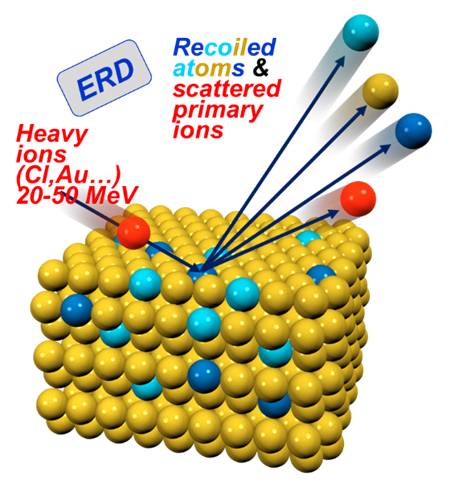
Elastic Recoil Detection Analysis (ERDA) : Detects atoms recoiling from the surface after ion impact, particularly useful for quantifying light elements such as hydrogen.

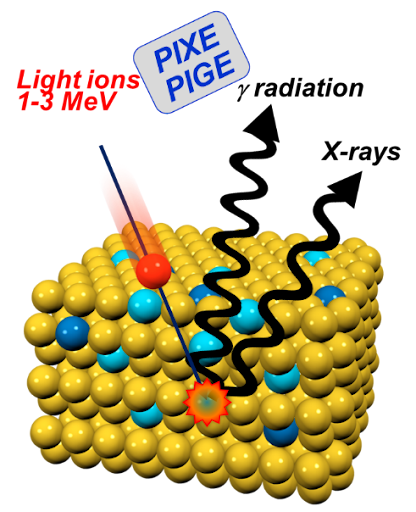
Particle-Induced X-ray Emission (PIXE) : Detects characteristic X-rays emitted when the incident ions ionize inner-shell electrons, allowing for multi-elemental analysis with high sensitivity.

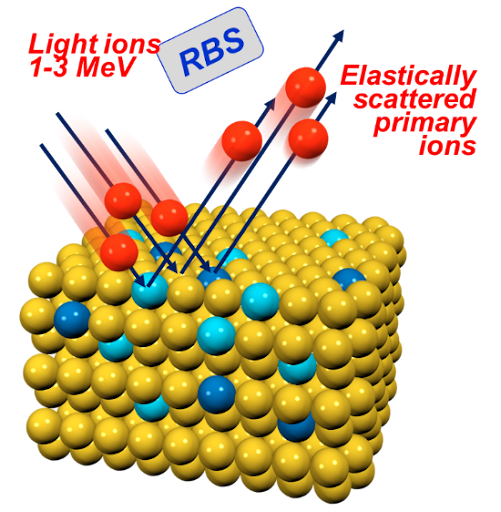
Rutherford Backscattering Spectrometry (RBS): Measures the energy of ions scattered elastically from nuclei, providing information on elemental composition and depth distribution.