
Publications
Publications 2017
- “A diagnostic test for cocaine and benzoylecgonine in urine and oral fluid using portable mass spectrometry”
Ismail M, Baumert M, Stevenson D, Watts J, Webb RP, Costa CD, Robinson F, Bailey MJ, Analytical Methods, 9(12), 1839-1847, 2017.
DOI: 10.1039/c6ay02006b - “Automated microbeam observation environment for biological analysis – custom portable environmental control applied to a vertical microbeam system”
England MJ, Bigelow AW, Merchant MJ, Velliou E, Welch D, Brenner DJ, Kirkby KJ, Sensors and Actuators B – Chemical, 239, 1134-1143, 2017.
DOI: 10.1016/j.snb.2016.08.076 - “High-energy ion beam analysis”
Grime GW, Encyclopedia of Spectroscopy and Spectrometry, 3rd Edition, 2:G-M, 103-121, 2017.
DOI: 10.1016/B978-0-12-409547-2.10993-X - “Hypervelocity impact in low earth orbit: finding subtle impactor signatures on the Hubble Space Telescope”
Kearsley AT, Colaux JL, Ross DK, Wozniakiewicz PJ, Gerlach L, Anz-Meador P, Griffin T, Reed B, Opiela J, Palitsin V, Grime GW, Webb RP, Jeynes C, Spratt J, Salge T, Cole MJ, Price MC, Burchell MJ, Procedia Engineering, 204, 492-499, 2017.
DOI: 10.1016/j.proeng.2017.09.746 - “Nanoscale properties of human telomeres measured with a dual purpose X-ray fluorescence and super resolution microscopy of gold nanoparticle probe”
Jeynes JCG, Geraki K, Jeynes C, Mi Z, Bettiol AA, Latorre E, Harries LW, Soeller C, ACS Nano, 11(12), 12632-12640, 2017.
DOI: 10.1021/acsnano.7b07064 - “Proton irradiation of CdTe thin film photovoltaics deposited on cerium-doped space glass”
Lamb DA, Underwood CI, Barrioz V, Gwilliam RM, Hall J, Baker MA, Irvine SJC, Progress in Photovoltaics, 25(12), 1059-1067, 2017.
DOI: 10.1002/pip.2923 - “Proton microprobe (method and background)”
Grime GW, Encyclopedia of Spectroscopy and Spectrometry, 3rd Edition, 3:N-R, 785-788, 2017.
DOI: 10.1016/B978-0-12-409547-2.12663-0 - “Rapid, secure drug testing using fingerprint development and paper spray mass spectrometry”
Costa CD, Webb RP, Palitsin V, Ismail M, de Puit M, Atkinson S, Bailey MJ, Clinical Chemistry, 63(11), 1745-1752, 2017.
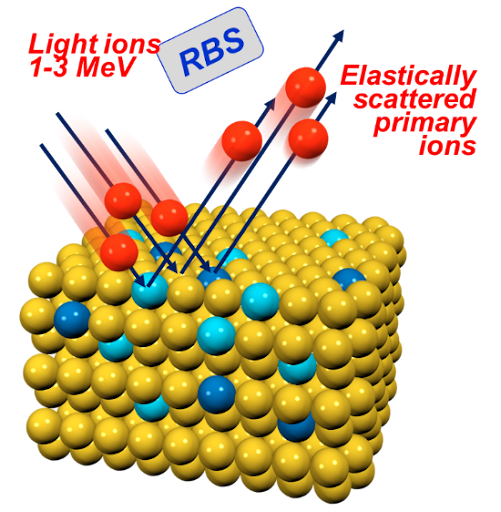
DOI: 10.1373/clinchem.2017.275578 - “RBS as a new primary direct reference method for measuring quantity of material”
Jeynes C, Nuclear Instruments and Methods in Physics Research B, 406, 30-31, 2017.
DOI: 10.1016/j.nimb.2016.11.041 - “Sidewall doping mechanism and doping profile tuning on 3D structure by plasma doping”
Wang C, England JE, Gossmann H, Persing H, Miller T, Gao Q, Tang S, Salimian S, IEEE 2017 17th International Workshop on Junction Technology (IWJT), 58-61, 2017.
DOI: 10.23919/IWJT.2017.7966515 - “Strategies for increased donor electrical activity in germanium (opto-) electronic materials: a review”
Monmeyran C, Crowe IF, Gwilliam RM, Michel J, Kimerling LC, Agarwal AM, International Materials Reviews, 62(6), pp334-347, 2017.
DOI: 10.1080/09506608.2016.1261223 - “Plant Cysteine Oxidases are Dioxygenases that Directly Enable Arginyl Transferase-Catalyzed Arginylation of N-End Rule Targets.”
M White, M Klecker, R Hopkinson, D Weits, C Müller, C Naumann, R O’Neill, J Wickens, J Yang, J Brooks-Bartlett, E Garman, T Grossmann, E Flashman, N Dissmeyer, Nature Communications, 8, 14690, 2017
DOI: 10.1038/ncomms14690 - “Post-fabrication phase trimming of Mach-Zehnder interferometers by laser annealing of germanium implanted waveguides”
X. Chen, M. M. Milosevic, D. J. Thomson, A. Z. Khokhar, Y. Franz, A. F. J. Runge, S. Mailis, A. C. Peacock, and G. T. Reed, Photonics Research, 5, 578-582, 2017
DOI: 10.1364/PRJ.5.000578 - “Monolayer-thick TiO precipitation in V-4Cr-4Ti alloy induced by proton irradiation“
A Impagnatiello, SM Shubeita, PT Wady, I Ipatovaa, H Dawson, C Barcellini, E Jimenez-Melero, Scripta Mat., 130, 174–177, 2017
DOI: 10.1016/j.scriptamat.2016.12.002 - “Thermal Evolution of the Proton Irradiated Structure in Tungsten-5 wt% Tantalum“
I Ipatova, RW Harrison, D Terentyev, SE Donnelly, E Jimenez-Melero J. Fusion Energy, 36, 234–239, 2017
DOI: 10.1007/s10894-017-0145-y - “Radiation-induced void formation and ordering in Ta-W alloys“
I Ipatova, PT Wady, SM Shubeit, C.Barcellini, A.Impagnatiello, E.Jimenez-Melero, J. Nuclear Materials, 495, 343–350, 2017
DOI: 10.1016/j.jnucmat.2017.08.029 - “Ti-rich precipitate evolution in vanadium-based alloys during annealing above 400 degrees C“
A Impagnatiello, T Toyama, E Jimenez-Melero, J, Nuclear Materials, 485, 122 –128, 2017
DOI: 10.1016/j.jnucmat.2016.12.040 - “Grain size threshold for enhanced irradiation resistance in nanocrystalline and ultrafine tungsten”
O El-Atwani, JA Hinks, G Greaves, JP Allain, SA Maloy, Materials Research Letters, 5(5), 343-349, 2017
DOI: 10.1080/21663831.2017.1292326 - “The effect of temperature on bubble lattice formation in copper under in situ He ion irradiation”
AM Robinson, PD Edmondson, C English, S Lozano-Perez, G Greaves, J Hinks, SE Donnelly, CRM Grovenor, Scripta Materialia, 131, 108-111, 2017
DOI: 10.1016/j.scriptamat.2016.12.031 - “Engineering self-organising helium bubble lattices in tungsten”
Harrison, R. W., Greaves, G., Hinks, J. A., Donnelly, S. E., Scientific Reports, 7, 7724, 2017
DOI: 10.1038/s41598-017-07711-w - “Effect of He Implantation on the Microstructure of Zircaloy-4 Studied Using In Situ TEM”
Tunes, M. A., Harrison, R., Greaves, G., Hinks, J., Donnelly, S., Journal of Nuclear Materials, 493, 230-238, 2017
DOI: 10.1016/j.jnucmat.2017.06.012 - “A study of the effect of helium concentration and displacement damage on the microstructure of helium ion irradiated tungsten”
Harrison, R. W., Greaves, G., Hinks, J. A., Donnelly, S. E., Journal of Nuclear Materials, 495, 492-503, 2017
DOI: 10.1016/j.jnucmat.2017.08.033 - “Thermal Evolution of the Proton Irradiated Structure in Tungsten-5 wt% Tantalum”
Ipatova, I., Harrison, R. W., Terentyev, D., Donnelly, S. E., Jimenez-Melero, E., Journal of Fusion Energy, 36, 234—239, 2017
DOI: 10.1007/s10894-017-0145-y - “Combining dynamic modelling codes with medium energy ion scattering measurements to characterise plasma doping”
J. England, W. Möller, J. A. van den Berg, A. Rossall, W. J. Min, and J. Kim, Nucl. Instruments Methods Phys. Res. B, 409, 60–64, 2017.
DOI: 10.1016/j.nimb.2017.05.043 - “Optical and structural characterization of Ge clusters embedded in ZrO2”
E.Agocs, Z.Zolnai, A.K.Rossall, J.A.van den Berg, B.Fodor, D.Lehninger, L.Khomenkova, S.Ponomaryov, O.Gudymenko, V.Yukhymchuk, B.Kalas, J.Heitmann, P.Petrik, Applied Surf Sci, 421(B), 283-288, 2017
DOI: 10.1016/j.apsusc.2017.03.153 - “Atomic layer deposition of ruthenium thin films from (ethylbenzyl) (1-ethyl-1, 4-cyclohexadienyl) Ru: Process characteristics, surface chemistry, and film properties”
M Popovici, B Groven, K Marcoen, QM Phung, S Dutta, J Swerts, J Meersschaut, JA van den Berg, A Franquet, A Moussa, K Vanstreels, P Lagrain, H Bender, M Jurczak, S Van Elshocht, A Delabie, C. Adelmann, Chem Mater, 29(11), 4654-4666, 2017
DOI: 10.1021/acs.chemmater.6b05437